AI · June 25, 2026 · 5 min read
SEO, AEO, GEO: how to be found when nobody clicks anymore
by Federica Grazia Bartolini

A third of the traffic, gone in a year. That’s what publishers’ websites lost from Google searches between 2024 and 2025, according to Reuters Institute data. And the people running those sites expect to lose nearly half over the next three years.
This is not a newspaper problem — I’ve dedicated a separate piece to what’s happening to publishers. It’s a mass shift in behaviour: people no longer search, they ask. They put a question to ChatGPT, to Claude, to an assistant — and get a packaged answer, no clicking required. The old pact — I write, Google sends me visitors — is breaking down in front of everyone.
For anyone with a business, a name, a reputation to defend, the consequence is worth stating upfront: being findable is no longer enough. You need to be cited. And, ideally, cited well.
Three acronyms, one game
Let’s put things in order, without jargon.
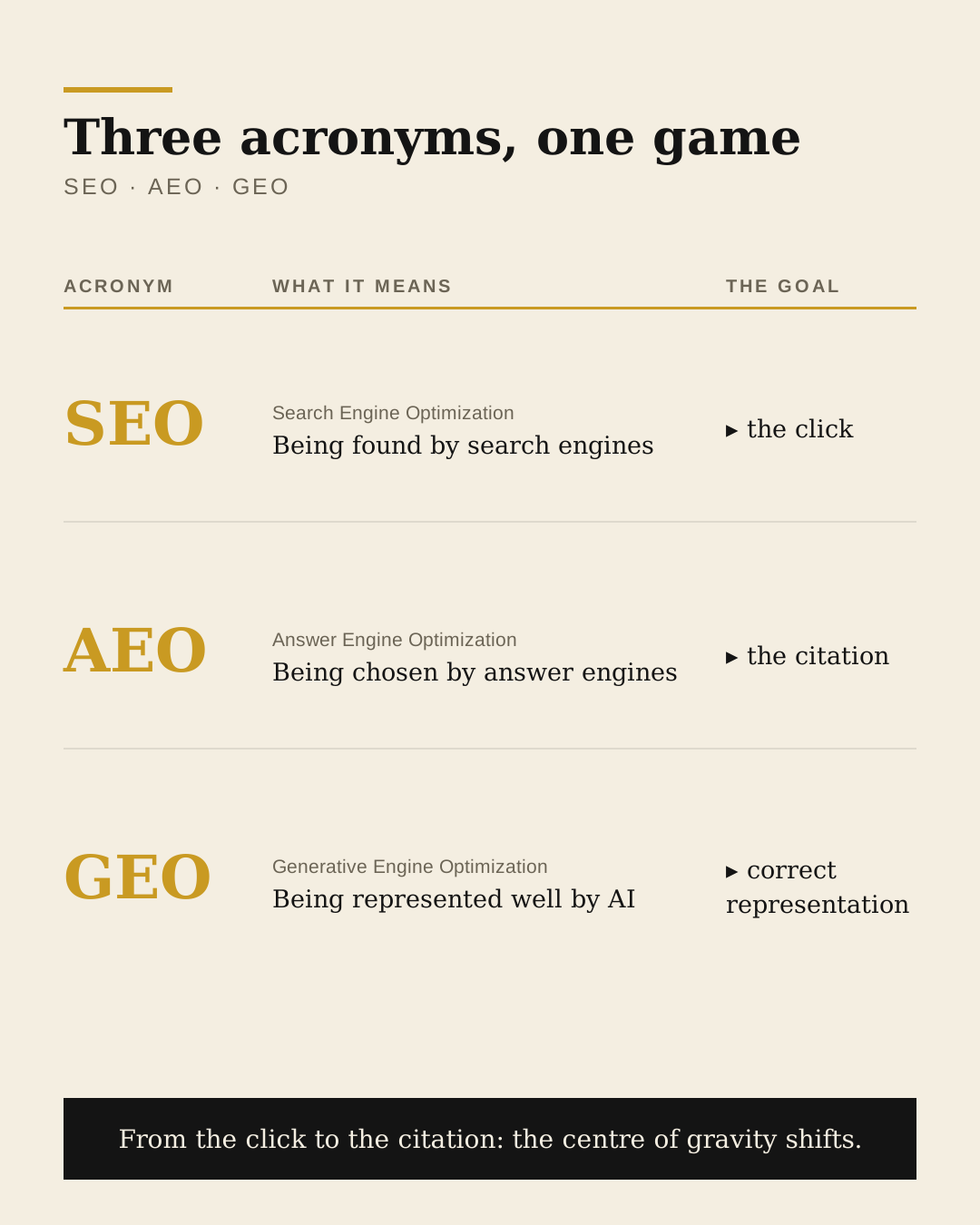
SEO — Search Engine Optimization — is the traditional craft: being found by search engines. The goal is the click: appearing in the results and bringing the person to your site.
AEO — Answer Engine Optimization — is the new craft: being chosen by answer engines. When someone asks an AI “who’s the best consultant for X?” or “how do you handle Y?”, the goal is no longer the click: it’s being inside the answer — cited, linked, or used directly as a source.
GEO — Generative Engine Optimization — is the broader sibling: making sure that when an AI generates content about you, it represents you correctly. Right name, right facts, right description.
Honesty is due here: the boundaries between the last two acronyms are still fluid and shifting, and the industry itself uses them almost interchangeably. But the substance doesn’t change: the centre of gravity is moving from occupying keywords to get clicked, to occupying the territories of artificial intelligence — being recognised and cited by the AIs themselves. The most unforgiving number in the 2026 Reuters report confirms it: today Google still sends websites 500 times the referrals ChatGPT does. Translation: the traffic AIs “give back” is, for now, little more than a rounding error — which is exactly why being inside the answers of ChatGPT, Claude and the rest matters so much.
What changes, in practice
Three things, and none of them is (only) technical.
First: machines reason in entities, not pages. An AI doesn’t “read your website”: it builds an idea of who you are — a person, a company, a method — by cross-referencing everything it finds. If your name appears in three different forms, with three different bios, across five different channels, the idea it forms is confused. And a confused machine doesn’t cite you: it cites someone else.
Second: whoever answers first wins — together with whoever has earned trust. AIs extract. If the answer to the question sits in the first paragraph, clear and complete, you have a shot at being the source. If it’s buried mid-ramble in paragraph twelve, you don’t. But careful: answering first gets you into the race; it doesn’t win it. When ten sources answer the same question well, what decides who gets cited is the authority of the entity: how consistent your data is, who cites you elsewhere, how long you’ve owned that topic, how much the machines — exactly like people — have learned to trust you. That’s why the three points on this list aren’t alternatives: they hold each other up.
Third: whoever defines their own concepts, owns them. If you are the one explaining, in black and white and in extractable form, what your method, your product, your idea is — the AIs will use your definition. If you don’t, someone else will write it for you. Or worse: the machine will improvise it.
My direct experience with my own website
I’m not speaking from hearsay: I applied what I’m about to tell you to my own website — this one. Here’s how I built it.
I put the entity in order: structured data that formally declares to the machines who I am — that “Federica Grazia Bartolini” and “Federica Bartolini” are the same person, that I’m the author of my book, the founder of my projects, the creator of my method. With explicit links to the profiles that represent me elsewhere, so the dots connect themselves. To do this, you need great clarity about the content you want to convey and about your goals.
Then, with Claude’s help, I created a file called llms.txt: in practice, a letter of introduction written specifically for AIs. It says who I am, what I do, what I’ve published, in my own words — so when a model looks for information about me, it finds the official version and doesn’t have to collage things together or invent pieces.
I built a page that answers literally the question people might ask: “Who is Federica Grazia Bartolini?”. It sounds trivial. It isn’t: it’s the difference between letting a machine assemble the answer and writing it yourself.
And I adopted a writing rule, for these articles too: the answer first, the depth after.
Will it work? I don’t know yet: it’s early to tell, and the rules of this game are changing faster and faster. But the principle underneath is solid, and it isn’t technological: be clear about who you are, say things in a way that can be picked up, own your version of the facts. Which is communication — the same craft as ever, with one more audience than the ones we’ve historically been used to.
There’s a paradox in all of this, and it’s the part I like most: to please the machines, you have to become more human. A recognisable voice, a clear position, a name that means something precise — being authentic and real. AIs cite the unmistakable. Everything else gets summarised — and whoever gets summarised, disappears.
Frequently asked questions
What is the difference between SEO, AEO and GEO?+
SEO (Search Engine Optimization) is about appearing in search results and earning clicks. AEO (Answer Engine Optimization) is about being cited inside AI-generated answers. GEO (Generative Engine Optimization) is about being represented correctly when a machine generates content about you. The boundaries between the last two are still fluid, and the industry itself uses them almost interchangeably.
Is SEO dead?+
No, it has split in two. Search engines still send traffic, but a growing share of questions now goes to an AI assistant that answers without anyone clicking. Working only on the click means covering half the game.
Where do you start if you want to be cited by AI?+
With three concrete things: a page that literally answers the question of who the subject is and what they do; answers written up front rather than buried at the end, so they can be extracted; and consistency across channels, because machines cross-check sources and discard whatever does not add up.
How much traffic have websites lost to AI answers?+
According to the Reuters Institute, between 2024 and 2025 publishers' websites lost roughly a third of their traffic from Google searches, and those running them expect to lose nearly half over the following three years.