AI · July 27, 2026 · 9 min read
You can publish AI-written text without a label. You just have to prove it
by Federica Grazia Bartolini
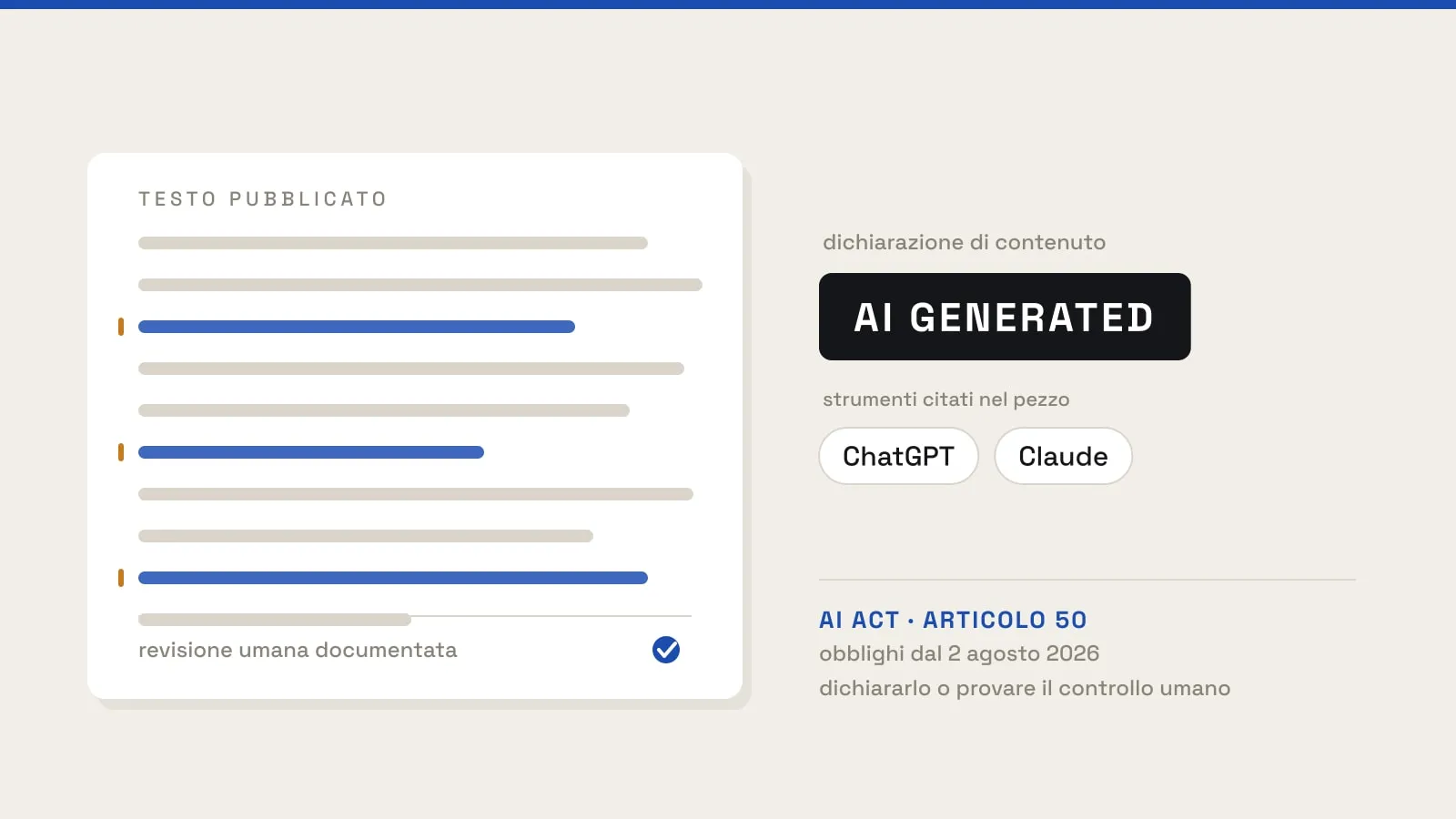
From 2 August, if you publish a text written or modified with artificial intelligence to inform the public on matters of public interest, you have to declare it. Unless that text has been through human review and there is someone — a person or a company — who takes editorial responsibility for it and therefore, in effect, signs it.
So the option of writing or modifying texts with AI without necessarily declaring it does exist, but you have to be able to defend it by producing evidence that the content went through human control. You need to track and record who checked what.
On 20 July the European Commission approved the final text of the guidelines on Article 50 of the AI Act. The obligations apply from 2 August. This is not one of the postponed deadlines: it is the only part of the transparency package left standing exactly as it was.
What Article 50 of the AI Act says
The provision is short and worth reading for what it says, not for how it is being reported. Anyone deploying an AI system that generates or manipulates text published in order to inform the public on matters of public interest must disclose that the text has been artificially generated or manipulated. The obligation falls away if the content has been subject to human review or editorial control and a natural or legal person holds editorial responsibility for the publication (text of Article 50, AI Act).
The guidelines of 20 July add the operational detail (European Commission). Two points deserve attention.
The first: the review must concern the substance of the content and must be carried out by people with the knowledge and judgement the subject requires. It is not a formal step. It is not the colleague who reads it over for typos and tidies up the commas — it is review on the merits.
The second, the one almost nobody is quoting: to rely on the exemption, whoever invokes it must document their internal review procedures.
Nobody formally asks you for a register, but you are asked to be able to demonstrate that the process exists. In practice, that means a register. And in practice, anyone who was planning to automate the production of articles, texts or any other content by delegating everything to AI and removing the human component not only cannot do it under these rules, but is required to prove they are not doing it.
”But I’m not a journalist…
…and the AI Act only regulates information of public interest”
It is the most common objection on this subject — and a fair one — and it comes from a misunderstanding about the perimeter.
The key is to understand what is meant by “public interest”, and in the guidelines public interest is defined broadly: politics and democratic processes, public administration, justice, fundamental rights, safety, health, the environment, consumer protection, and economic, financial, scientific or cultural developments relevant to public debate.
Read that list again while thinking about what you publish through or on behalf of your company. A position paper on sustainability. A contribution on the labour market. A note on the economic impact of a reform. A company blog post on organisational health. A statement explaining a reorganisation to employees, unions, the local community.
None of these things is journalism in the strict sense. And yet many of them inform the public on matters of public interest.
To this you have to add the Italian layer, which makes the whole thing less theoretical than it looks. The draft implementing decree of Law 132/2025, approved in preliminary examination in June and not yet final, provides that where damage results from the breach of an AI Act obligation, the causal link is presumed unless the defendant proves otherwise.
In the same text: compliance with the Regulation does not in itself exclude liability, and the injured party can bring a direct action against the insurer. It is a provision already under discussion — some object that tying civil liability to any breach whatsoever, including purely formal ones, goes beyond the scope of the European regulation. But the direction of travel is legible.
Translated: this is not only a question of fines — which in any case run up to 15 million euro or 3% of global annual turnover. It is a question of where you stand if it goes to court. And that moves the subject from the desk of the person handling compliance to the desk of the person handling litigation.
Why not declaring AI is harder than applying a label
Declaring the use of AI looks, today, like the simpler route — and the Code of Practice published in June has even provided a set of ready-made European icons, along the lines of “AI GENERATED” and “AI MODIFIED” (Altalex). To be copied and pasted at the top of the text.
Invoking the exemption is difficult. Because it means asserting: there was real review here, done by someone competent, and I take responsibility for it. An assertion that, if challenged, you have to sustain. With what?
Here are the questions you need to be able to answer on the day someone asks. Who reviewed that text. Which sources they verified. What they changed compared with the draft. Who approved publication. And why you decided the label was not needed.
If the answer is “we remember”, it is not an answer.
Let me add the honesty this subject deserves: there is no threshold. There is no percentage of modified text beyond which you are safe, no number of minutes of review that puts you in the clear. It is a grey area, and anyone selling you a numerical certainty on this is selling you something. What you can build is a defensible practice, not a free pass.
On top of that, the guidelines make clear that employees or contributors of a company acting within its instructions are not treated as independent deployers: responsibility remains with the legal person. So it is not the individual who used ChatGPT who answers for it — it is the company.
What I found out building my own newsroom
Over these past weeks I have been building a system that drafts my content. Not a toy: it starts from an input of mine and, on that basis, looks for signals, assesses whether a topic really concerns me, does the research, tries to take my thesis apart before I publish it, writes a draft, proposes a date and a visual. Then it stops. I decide: approve, edit, move, reject.
I designed it for two very selfish reasons, neither of which was regulatory compliance. I wanted the system to learn from my corrections — so it had to record the initial draft and my final version, and the difference between the two. And I wanted not to lose editorial control while delegating the operational work of researching across multiple sources — so every step had to leave a trace of who did it and why.
Then I read the guidelines and realised I had built, without meaning to, exactly the documentation you need in order to fall within the exemption. Who wrote the draft, which sources were verified, what I changed, when I approved it, on what grounds.
Part of me finds this reassuring, because it means my thinking is aligned with what is taking shape in Europe: avoiding indiscriminate automation, attributing authorship to what gets published, demonstrating that the editorial responsibility you claim is a responsibility somebody actually exercises.
It is not a labelling problem — it is a wider question of responsibility and of how we use AI
The convenient reading of these weeks will be: let’s add a disclaimer and stop worrying. It is the wrong reading, and for a reason that has nothing to do with the rule itself.
If you choose the label, you are telling your audience that a machine wrote this content and nobody put their face to it. It is lawful, it is transparent, and it is also a statement about how much what you publish is worth. If instead you choose the exemption, you are saying the opposite: there is a person in here who answers for what has been written. You cannot say it if it is not true, and you cannot prove it if you do not track it.
In any case, the company is responsible for what it publishes — whether at the hand of an employee who used AI or one who did not.
The stated rationale is not the protection of jobs, because nothing stops anyone from producing content with AI. It only requires you to say so, or to have someone answer for it.
The aim the Commission states is to put people in a position to recognise when they are interacting with an AI system and when a piece of content has been generated or modified, so as to reduce the risk of deception and manipulation. The problem it addresses is the growing difficulty of telling what was machine-generated from what was not — not the quantity of synthetic content, but its indistinguishability.
So, by design, the rule does not protect workers. It protects the reader’s ability to calibrate trust. Knowing whether there is a person behind a text who answers for it is information that changes the weight you give it — especially on health, on justice, on democratic processes. It is the same principle as a food label: it does not stop you eating badly, it tells you what you are eating.
And there is a second function, less visible: the editorial exemption creates an asymmetric incentive. Anyone who wants to avoid the label has to build a real, documented human process. It is not a ban on automating — it is the price of not declaring the automation, and the price happens to be exactly the thing that makes content potentially better and certainly more authentic.
Be aware, though, that the label will probably be read in a “negative” register, in terms of how reliable and how valid the content is perceived to be. It will be interesting to watch how this develops.