AI · July 16, 2026 · 9 min read
How to talk to your employees about AI without spreading fear (and how not to: the Duolingo case)
by Federica Grazia Bartolini

Most companies think fear of AI comes from AI.
I believe the opposite is true.
Fear comes from how we communicate change.
The Duolingo case proves it almost perfectly — and it’s recent enough, and close enough to what’s happening in companies today, to be worth examining together.
On 28 April 2025, Duolingo’s CEO, Luis von Ahn, made official internally — and then republished externally — the decision to make the company «AI-first»: artificial intelligence would progressively replace, where possible, external contractors, in a cost-cutting logic; it would enter business processes; and knowledge of AI would become one of the KPIs for evaluating employee performance, as well as a requirement for new hires, which would happen only where AI solutions weren’t enough.
On paper, a sensible strategy — similar to the one dozens of companies are adopting these very months.
A communication that, from what public sources tell us, was delivered first internally to employees informally, then through meetings and addressed with Q&As — which I consider a best practice, if well executed — and only afterwards shared externally.
What went wrong
We’ve all heard at least once that actions speak louder than words. And in Duolingo’s case, they seem to have weighed a great deal. The various audiences of Duolingo’s communication gave more weight to the consequences of the new decision-making criteria — on staffing, on external contractors, on performance reviews — than to the reassurances about job security and the “people first” approach, even though those reassurances were contained in the very same message.
The logical leap is this: when an announcement contains both promises and operational criteria, people believe and pay more attention to the latter, because they signal the company’s actual direction.
It isn’t true, in fact, that Duolingo “lacked reassurances” or “communicated too little”. If you reread the original memo — published by von Ahn himself — the reassurances are there, and they’re explicit. The CEO writes, in black and white, that «this isn’t about replacing Duos with AI», that the company «will remain a company that cares deeply about its employees», and that there will be «more training, mentorship and tooling» in support. So it isn’t a problem of missing reassurances.
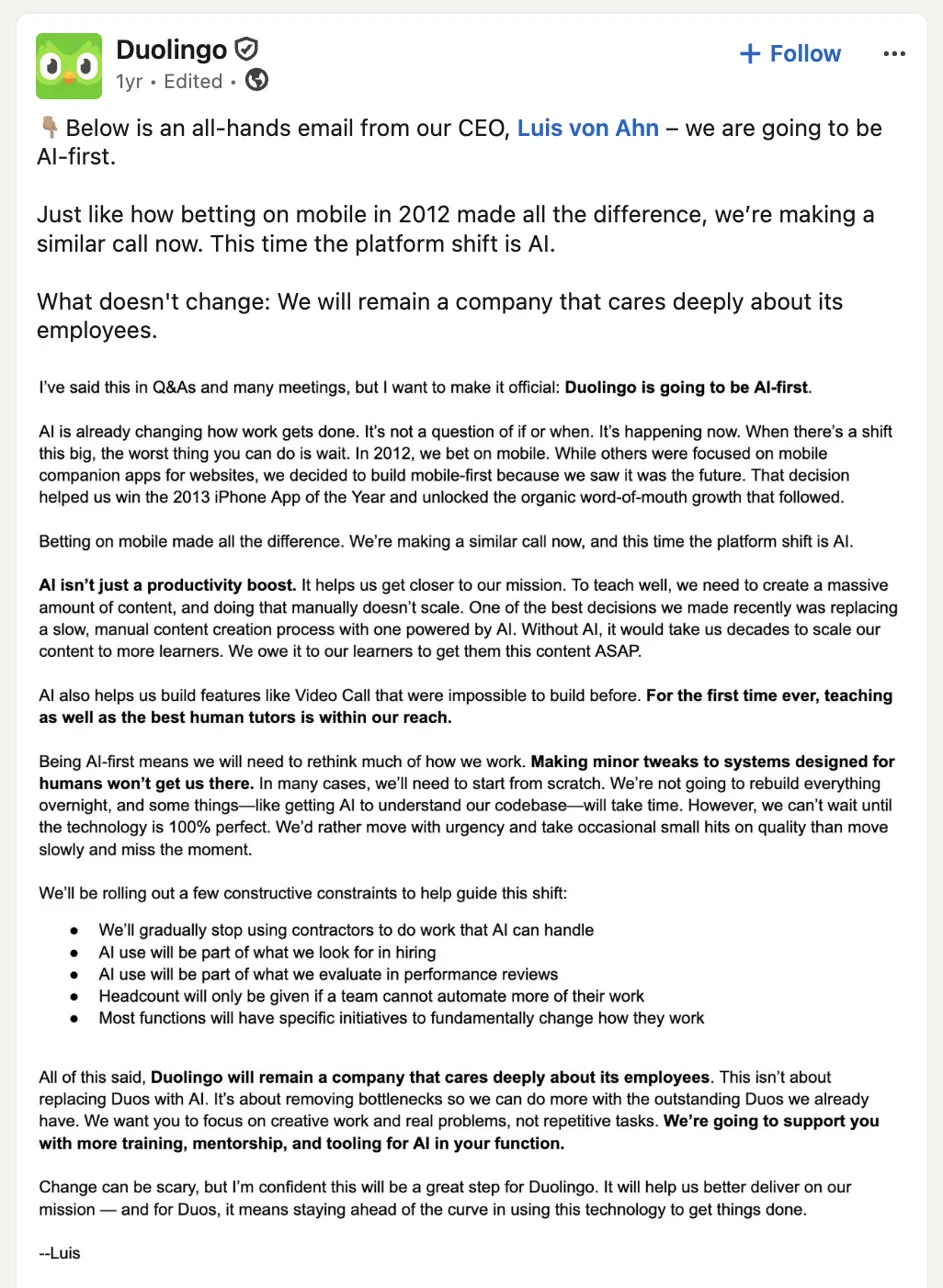 Luis von Ahn’s «AI-first» memo, April 2025 (source: LinkedIn)
The problem is that those reassurances coexisted, in the same email, with a list of very concrete operational criteria: they would gradually stop using external contractors for work AI could absorb; AI use would become part of performance reviews; new headcount only where a team couldn’t automate more. On one side, “we care about you”; a few lines below, the criteria by which, from that moment, decisions would be made. And the audience — inside and outside the company — did what we all do when we sense a threat: it listened to the criteria, not the intentions.
There’s an even deeper level, and it’s what makes the case genuinely instructive. The phrase “AI-first” wasn’t wrong in itself: the point is that it redefined the organisation’s hierarchy of priorities. Before, implicitly, the criterion was “we start from people and see how technology can help them”. After, it became “we start from AI and see where people are still needed”. For an investor, that’s a promise of efficiency. For an employee, it’s a reversal of their place in the design. For a customer, it may become, one day, a question about service quality. Same phrase, three different meanings — and no one had defused them beforehand.
A clarification, because I don’t want to claim more than the facts allow. I don’t know whether, before the announcement, work was done to prepare the key stakeholders — investors, managers, middle layers. Public sources don’t say, and it would be wrong to assert it. What we can say is more solid and, come to think of it, almost more interesting: if that work was done, it wasn’t enough to prevent the public crisis; if it wasn’t, it’s a plausible explanation of what happened. Either way, the result is the same — the narrative slipped out of the company’s control.
And here’s the heart of the matter, which goes well beyond “they communicated badly”: the point is not whether a message is correct, but what meaning it takes on for each audience that receives it. Duolingo didn’t communicate too little. It underestimated the weight the same communication would carry for different audiences — and the distance between what it said it wanted to be and the criteria by which it declared it would decide.
Trust in management eroded. People felt replaceable, somehow threatened. And the sharpest clarification — that no one would lose their job — when it arrived, under pressure, sounded to many like a patch applied mid-course, if not an added insult. The same sentence, said before and in the right context, might have prevented much of the fallout. Communicating change is (also) a matter of sequence, as well as method.
The lesson, as I see it, is this: when you introduce a change as big as AI into a company, how you communicate it weighs as much as what you’re doing. People’s fear doesn’t come from AI: it comes from what you say — and above all from what you let them infer — about that change.
When changing your mind is an act of leadership
The story, though, didn’t end there — and the ending is the most instructive part.
In April 2026, almost a year after the memo, von Ahn announced that Duolingo dropped even its most contested policy: evaluating employees based on their use of AI. Employees had started asking whether they should use AI “just for the sake of using it” — and the CEO’s final answer was: what matters is doing your job well; AI often helps, «but if it doesn’t, I’m not going to force you». With a diagnosis that is almost self-criticism: we were pushing a tool, instead of evaluating results.
To be fair, the whole picture: Duolingo keeps other constraints from the original memo (the halt on external contractors where AI suffices) and maintains it never laid anyone off. But the point, for anyone who works in communication, stands — and it’s enormous: policies imposed from the top, without a pact with people, risk backfiring the moment they hit reality.
The Golden Bridge® Method applied to the Duolingo case
The Golden Bridge® Method would have helped handle this whole affair holistically. Let’s try to reread the case through the lens of the Method.
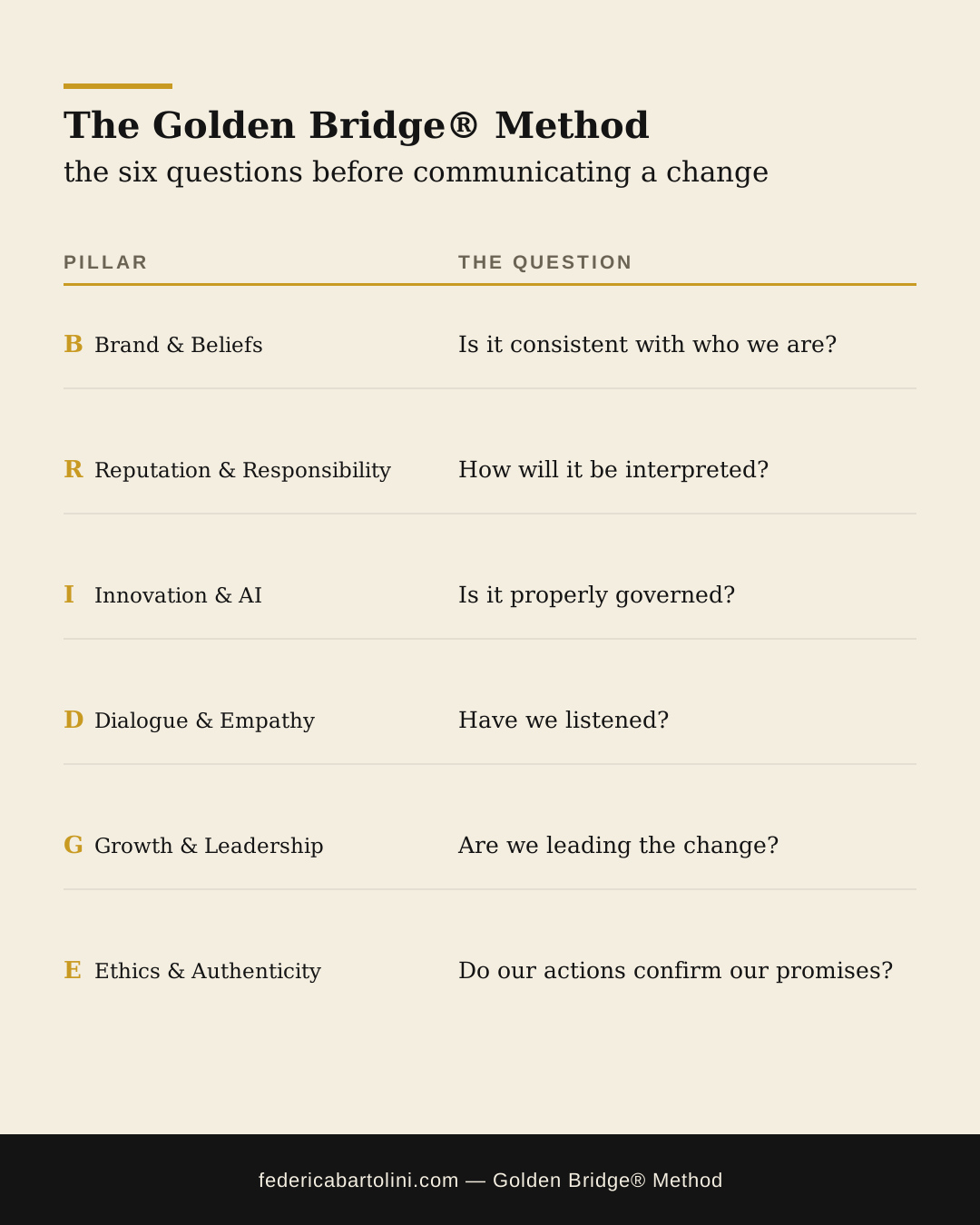
The first pillar is what I call Brand & Beliefs — identity. Duolingo is a brand built over the years on lightness, on play, on an affectionate tone: people grew fond of that owl. When an announcement is perceived, externally, as “the company is putting AI in place of people”, it clashes with the image the public has built. I don’t think the strong reaction was a judgement on the strategy itself: it looked more like a sense of disappointment, the kind you feel when someone you associate with certain values suddenly seems to contradict them.
Then there’s reputation and responsibility. Part of the work of communication — perhaps the least visible — consists of asking, beforehand, how every word will sound once it leaves the company’s perimeter: reworded, condensed, perhaps taken out of context. It’s a tedious, unglamorous exercise, but it’s exactly what separates a stewarded announcement from one left to chance.
On the innovation front, I think the most debatable point was tying the use of AI to people’s evaluation. When you start from the tool — “use AI, and we’ll measure you on how much you use it” — instead of from the goal, you put the cart before the horse. And it’s probably no coincidence that this is precisely the part that, a year later, was withdrawn.
The pillar closest to my heart, though, is the one about dialogue and listening. The internal Q&A sessions were there, and as I said I consider them good practice. But listening, to work, can’t be a one-off moment: it has to stay an open channel over time. The question employees began asking themselves — “are they asking us to use AI just to use it?” — was a precious signal. It was picked up, but a year late. And a year, in these matters, is an eternity.
I’d also like to say something on the positive side, because it seems only fair. Publicly admitting a U-turn, as von Ahn did, is neither obvious nor weak: it’s a form of leadership I find credible, far more credible than an announcement that pretends never to have wavered. Authenticity, even when it arrives late, remains the thing that mends trust. And indeed, in the end, something was mended.
From all this, in my experience, a sequence emerges. Not a magic formula — I distrust formulas — but an order I’ve seen work, when communicating a big change to people.
-
What we’re changing / automating, and why: concretely, not in slogans.
-
What isn’t changing. It’s the sentence people wait for more than any other, and that almost no announcement contains. If there are roles, skills, presences that remain, it’s worth saying so right away — before fear fills the silence with its own answers.
-
What the benefits are, what we’ll learn.
-
What we don’t know yet. It’s the part that frightens leaders most, and in my view the one that pays off most. Saying “on this we don’t have an answer yet, we’ll give it to you by a certain date” doesn’t weaken leadership: it makes it human and credible. False certainties, built to reassure, crumble at the first contradiction — and take with them what little trust was left.
This sequence shouldn’t be entrusted to a chain of emails: it should pass through managers. A document informs; a conversation, done well, reassures.
The question beneath the question
There’s one final level, and it’s what separates the companies that navigate this season well from the rest.
When people ask “will AI replace me?”, the real question is another one: does this company see me as a cost to optimise, or as a resource of value that can’t be replaced? That question isn’t answered with an announcement — it’s answered with consistency between what you say and what you do in the months that follow. Duolingo learned it under pressure, over a year of corrections.
I’ve written about it in the context of transformations that fail: communication isn’t the megaphone for decisions — it’s one of the ingredients of respect and transparency towards people, while everything changes. With AI, that pact counts double: because this time the change doesn’t concern a department or a process. It concerns the idea each person has of their own place in the world.
And a promise, by definition, isn’t just announced. It’s kept.