Events · November 27, 2026 · 7 min read
NOWE 2026: how AI is changing the way we work
by Federica Grazia Bartolini
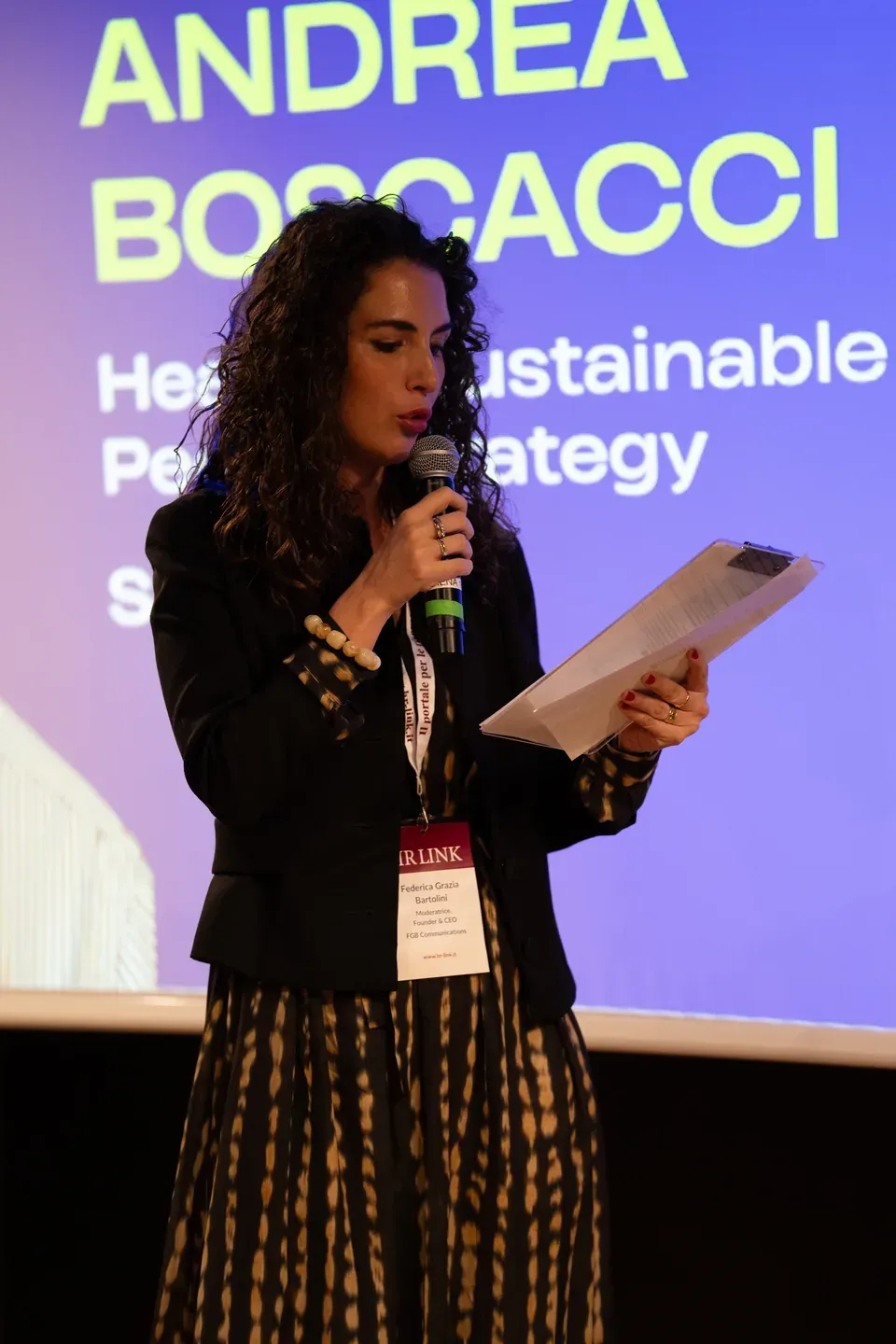
I had prepared two questions to open NOWE. The first was for anyone whose company had at least one AI pilot underway. The second was for anyone who already had a project embedded in day-to-day work, with a named person responsible, a measured outcome and clear KPIs.
The room was full of senior people from companies at the forefront of innovation, so the gap between the two shows of hands was fairly small. There was still a gap. On 25 November 2026 I hosted and moderated the inaugural NOWE at Talent House by The Adecco Group in Milan. NOWE is an executive forum organised by HR Link, with FGB Communications as Content Partner.
Simona Ciotti, Business Director & Co-owner of HR Link, welcomed everyone and opened the event with “Why talking about AI tools is no longer enough”. Elena Panzera, Senior Vice President HR EMEA and AP at SAS and President of AIDP Lombardia, brought the perspective of HR leaders with “AI can do the work, and we choose who to be”.
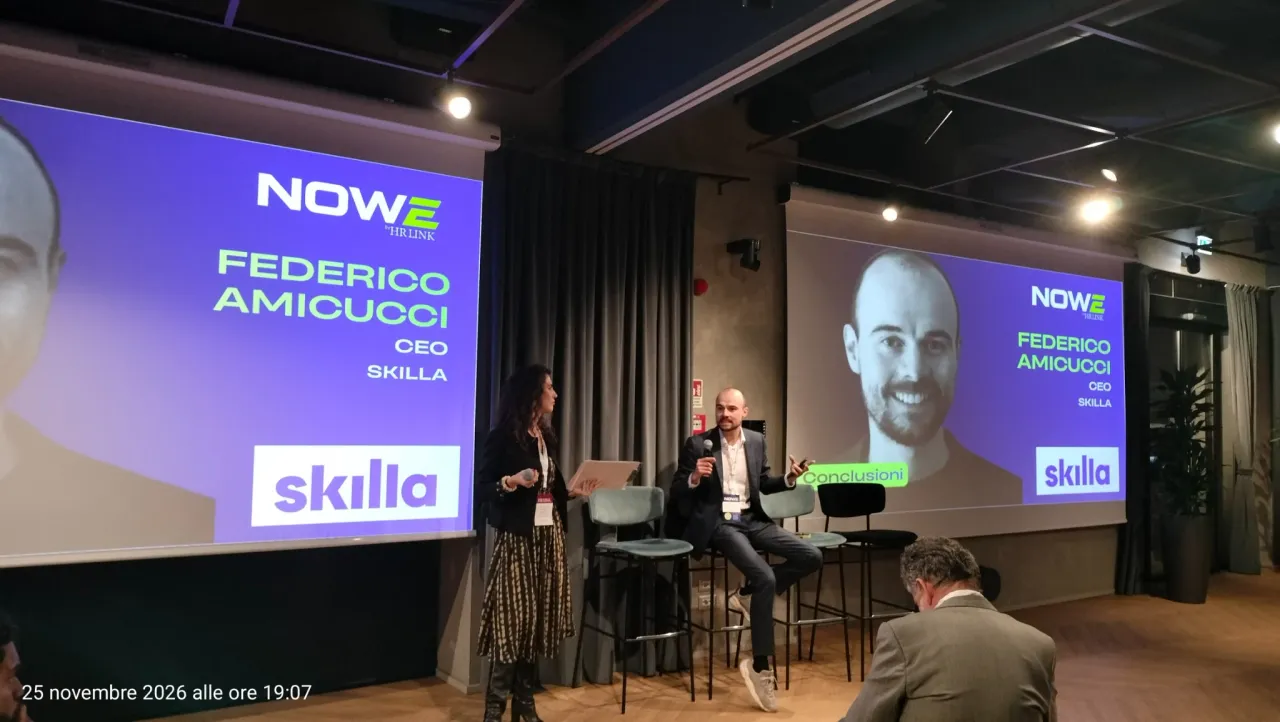
Federico Amicucci, CEO of Skilla, opened the discussion with “AI: from experimentation to impact”, sharing how Skilla had transformed its own work. In his closing remarks, he drew together the themes we had discussed throughout the day.
Who leads the transformation?
I put that question to Manuela Paulon, Head of Organizational AI Consultancy at The Adecco Group. In “AI: from tool to cognitive infrastructure”, she explored what changes when AI becomes part of how a company organises work, and what that means for the skills people need. My takeaway was that we need people who can think critically. I wonder how ready we are to manage them after so long organising work along Fordist lines.
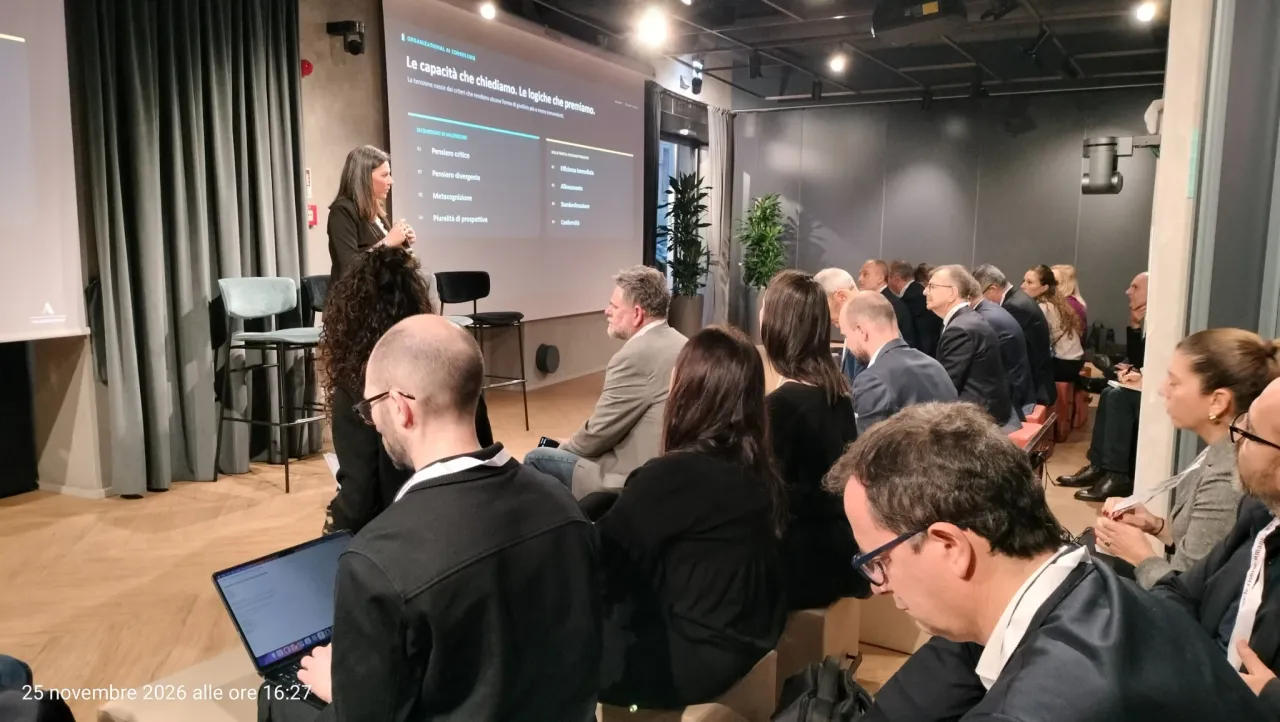
With Flavio Bordignon, President of DORG Society, we took a look at a future that is already here. In “The digital employee: what it is and what it means”, we discussed how a digital employee fits into a complex company. We returned to the subject in “How to manage a digital employee”. People still have an active role. Someone has to assign the work, check the results and decide when to step in. Above all, someone has to take responsibility when things go wrong. It’s all too easy to blame the AI (and the law would not let us off the hook, either).
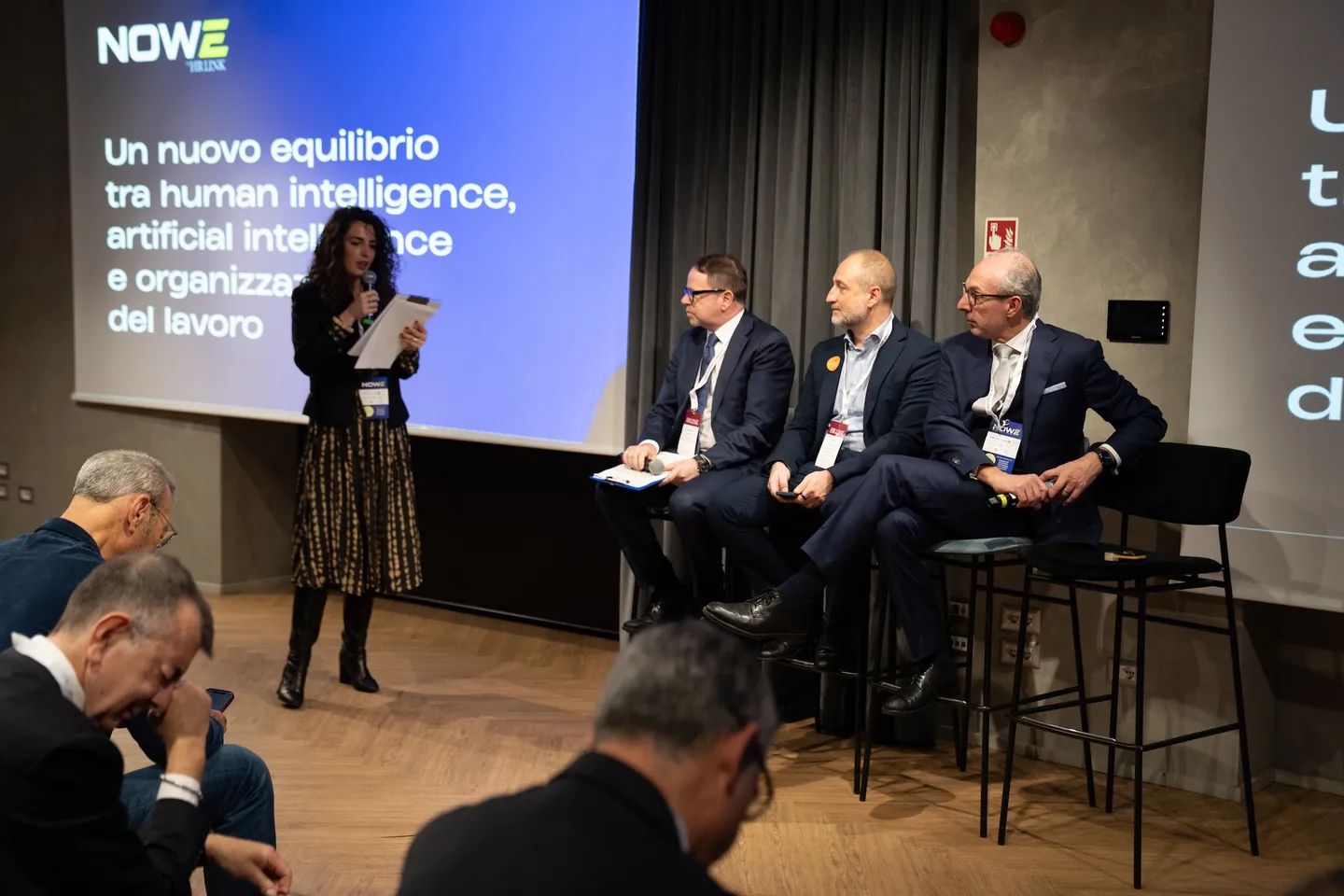
In the roundtable “A new balance between human intelligence, artificial intelligence and the organisation of work”, we heard how major companies including Eni, Saipem and Engineering are tackling these changes.
With Gian Luca Grondona, Chief Corporate Officer, we discussed the transition from individual productivity tools to AI that supports business processes. I asked Massimiliano Branchi, Head of Human Resources and Organization at Eni, what governing AI means in a complex organisation and how HR can help people develop the skills they need. With Andrea Boscacci, Head of Sustainable People Strategy at Saipem, we discussed the role of technical and interpersonal skills in managing change. Alessandro Bruscia, Chief People, HSEQ and Sustainability Officer at Saipem, also attended.
In her video contribution, Alessia D’Addario, Group Chief HR & Organization Officer at Engineering, described the approach her company takes. The Chief AI Officer leads the AI offering for clients. The CIO leads internal adoption and works with HR on training, communication and how roles evolve. Engineering has also introduced a role that works with process owners to redesign how people and AI systems work together.
What do we do with the time we free up?
In “From insight to decisions: analytics and KPIs for governing AI transformation”, Federico Giullari, Director of the Centre of Excellence Human Capital at BIP Group, explored how to measure what AI is changing at work.
In “The productivity trap: shadow AI and the new boundaries of work”, Professor Aurelio Ravarini, Professor of Organisation and Information Systems at LIUC – Università Cattaneo and Director of its Digital Transition Hub, discussed shadow AI, the use of AI tools outside company channels or rules. In “Where to find AI skills”, Andrea Benigni, CEO of ECA Italia, broadened the discussion to the availability of specialist skills and how Italian companies can access them.
With Luigi Corvino, Academy and Training Manager at the Italian Institute of Artificial Intelligence (AI4I), we turned to return on investment. His talk was titled “AI ROI and personal effectiveness. How AI changes the way we work, make decisions and create value”. The first edition of Atlante AI, the AI4I and Bain & Company study of 320 businesses, reported 86% adoption and 19% deployment at scale.
Corvino offered an example that shifts the discussion towards the quality of decisions. If a team can produce twenty analyses in the time it used to take to produce two, which analyses are actually worth doing? In the written version of his remarks, he poses a further question that I would put at the heart of any project: “And what do I do with the capacity I’ve freed up?”
Consider an assistant that answers employees’ most common questions. If every complex case goes to a manager, the time HR saves can reappear as extra work elsewhere. To see whether the process has improved, I would measure time spent, the quality of the answers and the workload across teams.
Communication strategy starts on day one
This is where I see communication playing an increasingly decisive role. Communicating well is part of managing well.
Good communication helps people understand how a process is changing and, above all, why. It helps managers talk to their teams and gets the questions raised by people using the new system back to those making the decisions. It makes reskilling and organisational change easier to put into practice.
Too often, people hear about change after the decisions are made, through a top-down announcement or a dry policy document. People trust what they see more than what they are told. An omission can quickly be read as a lie, and it takes very little to undermine trust and engagement.
Communication needs to help shape an AI project from the start.
These conversations reinforced my conviction that the Golden Bridge® Method has a role to play in managing this transformation. I set it out in my book Governare l’impatto dell’AI in azienda. Il metodo Golden Bridge® per una strategia applicativa (FrancoAngeli).
That is part of what we do every day at FGB Communications. We communicate change from the earliest stages, give managers the tools to explain it to their teams, and put ways of listening in place so that decision-makers hear what people are asking on the ground.
Thank you
Thank you to HR Link and Simona Ciotti for creating the first edition of NOWE and trusting me to host it. Thank you to all the speakers who shared the stage with me, to our partners Skilla, BIP, DORG, ECA Italia and The Adecco Group, to our supporters EFI Ecosistema Formazione Italia and Challenge Network, and to AIDP, LIUC and AI4I.
Further reading · HR Link Magazine · Simona Ciotti on LinkedIn.
Photography · Simone D’Addazio (@morksar)